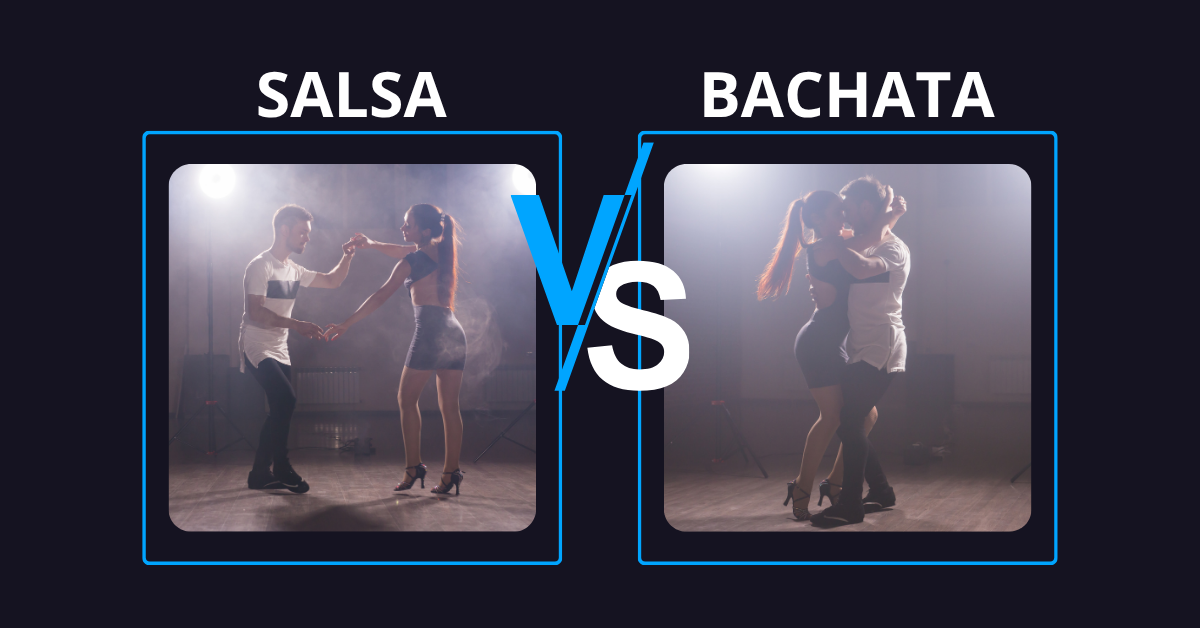
It is the ultimate crossroads for every beginner. On one hand, you have Salsa—energetic, fast-paced, and universally recognized. On the other, you have Bachata—sensual, rhythmic, and sweeping across dance floors worldwide at an unprecedented pace. Here is classic dancer’s dilemma: Salsa or Bachata?
Many beginners fall into the trap of thinking they have to choose one and abandon the other forever. In reality, most Latin dancers eventually learn both. However, where you start matters. Your first dance style shapes your rhythm, your partner-work fundamentals, and your initial confidence on the social dance floor.
Let’s break down the mechanics, the music, and the learning curves of both dances so you can decide which one deserves your first pair of dance shoes.
1. The Anatomy of Salsa: High Energy and Complex Geometry
To understand why people call Salsa “spicy,” you have to understand its roots. Born from a fusion of Cuban rhythms (like Son and Mambo) and American jazz in the streets of New York City during the 1960s and 70s, Salsa is a high-octane, polyrhythmic dance.
The Rhythm and Timing
Salsa is danced to a 4/4 time signature, but it is counted across an 8-beat phrasing cycle. You take three steps over four beats of music, followed by a pause (or a tap/slow movement) on the fourth beat.
What makes Salsa challenging for beginners is not just the speed, but the polyrhythmic nature of the music. In a single Salsa track, you have a conga drum playing one rhythm, a cowbell striking another, a piano playing a syncopated montuno, and a horn section driving the melody. Finding “beat 1” amidst this wall of sound can feel overwhelming to an untrained ear.
The Movement Mechanics
Salsa is highly structural and geometric. Depending on the style you learn, the movement happens along specific pathways:
- Linear Styles (LA Style / New York Style): Danced on a strict “slot” or line. Dancers execute rapid turns, spins, and cross-body leads, moving back and forth like a pendulum.
- Circular Styles (Cuban Salsa / Casino): Dancers move in a circular, rotational pattern around each other. It is earthy, playful, and focuses heavily on complex arm tangles (known as nudos).
Because Salsa incorporates multiple spins, sudden direction changes, and fast footwork (shines), it requires a high degree of core stability, balance, and quick reflexes.
2. The Anatomy of Bachata: Rhythmic Grounding and Sensual Flow
Originating from the rural countryside of the Dominican Republic, Bachata was historically a music of heartbreak, romance, and melancholy. For decades, it was marginalized in its home country, but today, it has evolved into a global phenomenon with various sub-genres.
The Rhythm and Timing
Like Salsa, Bachata is in 4/4 time, but its rhythm is much more straightforward. You take three steps and a distinctive hip tap on the fourth beat.
The music is driven by a unique instrument lineup: the bongo drum dictates the heavy, predictable heartbeat of the song, while the requinto (lead guitar) weaves melodic improvisations over the top. For a beginner, finding the beat in Bachata is incredibly intuitive because the bongo accentuates the 4th and 8th beats perfectly, giving you a clear cue to tap your foot.
The Movement Mechanics
While Salsa moves linearly or in large circles, traditional Bachata is danced in a compact square or side-to-side box step. The emphasis is on the lower body—specifically the knees and hips.
However, modern dance floors are dominated by two main evolutions:
- Traditional/Dominican Bachata: Fast, playful footwork with a focus on syncopation and rhythmic changes.
- Sensual Bachata: A style popularized in Europe that incorporates body waves, head rolls, and isolations. It requires close physical connection and smooth, fluid partner teamwork.
3. The Core Argument: Why Salsa is the Ultimate “Gatekeeper” Dance
There is a widely accepted maxim in the Latin dance community: “If you learn Salsa first, Bachata will be a breeze. If you learn Bachata first, Salsa will feel like climbing a mountain.”
There is profound truth to this. Salsa acts as an intensive bootcamp for dance fundamentals. By choosing Salsa as your foundational dance, you are forcing yourself to master high-level skills right out of the gate.
With salsa might feel frustrated for the first month or two as your brain tries to process the music and the fast footwork. But once it clicks, you possess the keys to the kingdom. You can walk into any Latin dance event in the world and hold your own.
4. The Counter-Argument: Why Starting with Bachata is Great for Confidence
While Salsa builds incredible technical discipline, it can also intimidate people right out of the hobby. This is where Bachata shines as an introductory dance.
Instant Gratification and Social Survival
The learning curve for basic Bachata is remarkably gentle. A complete novice can walk into a 45-minute beginner Bachata class and comfortably dance through an entire song at a social party that very night.
Because the basic step is a simple side-to-side motion, your brain does not have to work overtime just to stay on time. This instant success builds immediate confidence. For people who are anxious about dancing in public, Bachata provides a safe, welcoming space.
With Bachata you will experience less frustration early on. However, be warned: if you stay in the “Bachata bubble” for too long, transitioning to Salsa later can feel jarring because your brain will be accustomed to a much slower, more forgiving tempo.
5. The Comparative Breakdown
To help you visualize how these two powerhouses stack up against each other, let’s look at their core attributes side-by-side:
| Feature | Salsa | Bachata |
| Tempo / Speed | Fast to hyper-fast (Typical: 160–220+ BPM) | Moderate to slow (Typical: 110–140 BPM) |
| Musical Complexity | High (Polyrhythmic, multiple percussion layers) | Low to Medium (Clear, melodic, distinct rhythms) |
| Primary Framework | Linear (slots) or Large Circles | Side-to-side, Box steps, or Close body contact |
| Physical Demands | Cardio-intensive, requires high agility & balance | Core control, flexibility, lower body isolation |
| Initial Learning Curve | Steep (Expect 4–8 weeks to feel comfortable) | Gentle (Expect 1–2 weeks to feel comfortable) |
| Social Dance Prevalence | Universal (Found at every Latin event worldwide) | Universal (Often shares 50/50 billing with Salsa) |
6. The Hybrid Approach: Can You Learn Both at the Same Time?
If you are ambitious, you might ask: Why not both? In almost every city, Latin dance socials are rarely “pure.” They are almost always marketed as “Salsa & Bachata” nights, typically alternating between two Salsa songs and two Bachata songs. Because the subcultures are deeply intertwined, learning them simultaneously is not only possible—it can actually be highly beneficial.
The Overlapping Chemistry
Despite their differences, Salsa and Bachata share a common linguistic DNA in dance. They both operate on an 8-count structure. They both utilize fundamental partner concepts like the “Cross-Body Lead” (moving the follower from one side of the leader to the other) and outside/inside turns.
When you learn them together, you start to notice striking similarities:
- A standard right turn in Salsa uses the exact same hand preparation and execution as a right turn in Bachata; it is simply executed at a different speed.
- The concept of “frame” (keeping your arms engaged to pass signals between partners) is completely identical.
To pull off the hybrid approach successfully, you need to train your ears. Listen to the music during your daily commute. Learn to identify the sharp crack of the Salsa clave versus the bright, metallic ring of the Bachata bongo. If your ears know which dance is playing, your feet will follow.
Final Thoughts on Salsa or Bachata
At the end of the day, there is no wrong answer. Salsa and Bachata are not rivals; they are siblings. They complement each other beautifully, offering two distinct ways to express emotion, connect with another human being, and lose yourself in incredible music.
If you want the ultimate technical foundation that makes learning all other Latin dances easy, take the Salsa path. If you want a smooth, confidence-boosting entry into the community that gets you dancing comfortably by tonight, take the Bachata path.